Thin Lizzy came out of Dublin in 1969, led by Phil Lynott on bass and vocals, with Brian Downey on drums and Eric Bell on guitar. The name came from Tin Lizzie, a robot in the British comic The Dandy. What most guitar players remember them for, though, is two guitars playing the same melody in harmony. Here’s how that sound came together.
It started with a folk song
Thin Lizzy’s first hit was an old Irish ballad, “Whiskey in the Jar.” It reached No. 6 in the UK in February 1973, and the band wasn’t thrilled about it, since it didn’t sound like the rest of their music.
Eric Bell had a hard time figuring out what to play on it. The idea finally came during a late-night drive home from a gig, when Phil had The Chieftains playing on a cassette. Bell heard the uilleann pipes and decided the guitar intro should sound like that. The actual lick came to him later in the back of a London cab. Bell says he writes most of his solos by humming them over the chords until something sticks, and that one took two or three weeks. That’s not a bad method if you’re stuck.
Enter Robertson and Gorham
Bell left at the end of 1973, and Gary Moore filled in for a while. In 1974 Lynott and Downey brought in two guitarists: Brian Robertson, an 18-year-old from Glasgow, and Scott Gorham, a Californian. Gorham says he was the 25th guitarist to audition and had 30 days left on his visa.
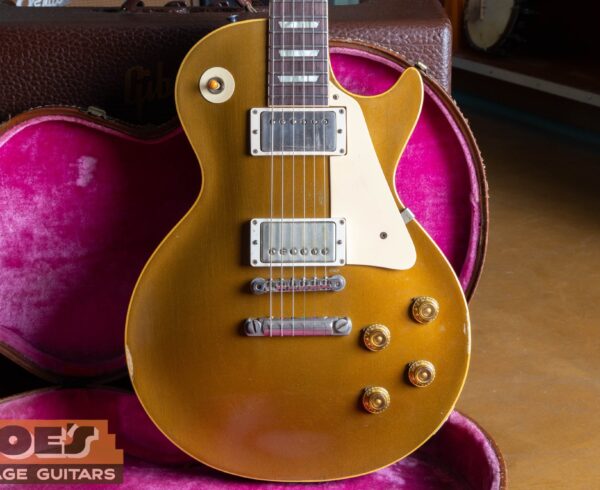
He also showed up with a cheap Japanese Les Paul copy. One of the first things Phil told him was, “Okay, you’re in, but we gotta change that guitar.” Gorham went out and bought a sunburst Les Paul, and the pair ended up on twin Les Pauls.
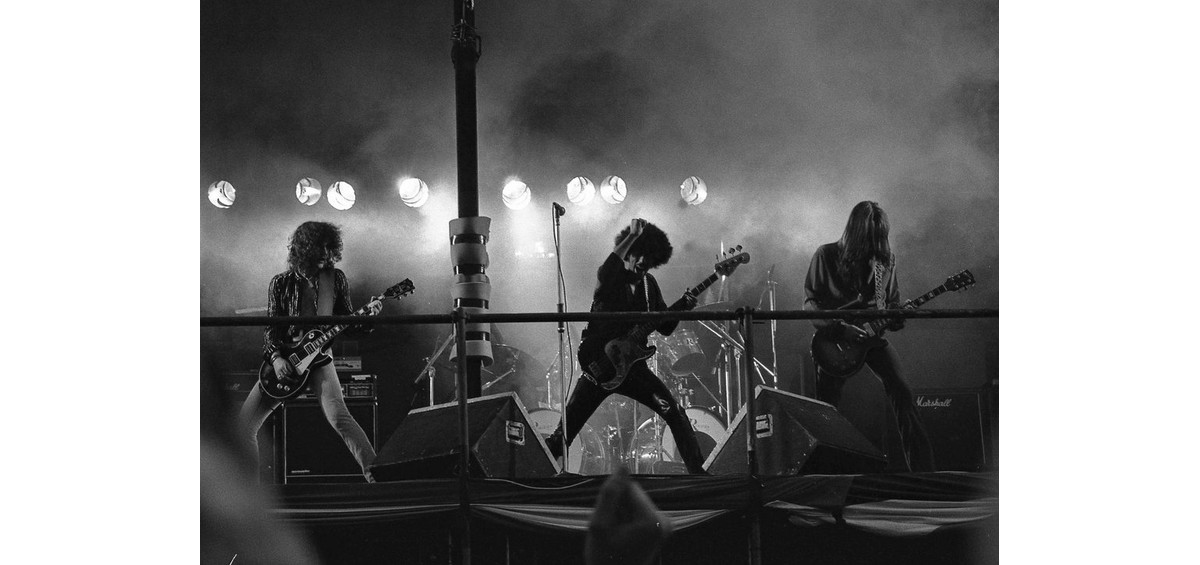
Phil Lynott and Scott Gorham at Pinkpop, 1978. Photo: Chris Hakkens
A happy accident
Gorham says the harmony thing started by accident. Robertson was recording a single line in the studio, and the engineer had a tape delay on it that fed back on itself in harmony. Robertson apologized. Gorham and Lynott thought it sounded great, so Gorham learned a harmony part and recorded it, and they started trying it on other lines too. You can first really hear it on “Wild One” from Fighting (1975).
Thirds, fifths, and matching vibrato
Gorham is pretty specific about how it worked. “We were all 5ths and 3rds, that was our whole thing,” he told Guitar World. He also says the vibrato has to match: “If one guy has a slow vibrato and the other guy is fast, that’s not gonna work.”
He’s also quick to say they didn’t invent harmony guitars, because country players had been doing it for decades. The difference was the songs. Country harmonies tend to sit on major chords, and Lizzy wrote a lot in minor keys, which made the same idea sound tougher. As for who played which part, they worked it out in rehearsal, and whoever played a part better got it.
A few riffs to chew on
- “The Boys Are Back in Town” from Jailbreak (1976). It went to No. 8 in the UK and No. 12 in the US, and the harmony lines are as famous as the chorus.
- “Emerald,” also from Jailbreak. Gorham calls it “just power riffs, which are a joy to play.” He also says that when he turned the volume up, “the Irish lines became power lines.”
- “Roisin Dubh (Black Rose)” from Black Rose (1979), with Gary Moore back in the band. It’s a long medley of traditional Irish tunes played as twin-guitar rock.
If you want to try the idea yourself, take a simple melody you already know and play it with a friend while one of you plays a third above. Stay in the key and let your ear decide when a note sounds off. A Guitar World lesson in the Lizzy style builds its harmonies mostly a third above the melody, with a few notes that break the rule so it doesn’t sound too predictable.
Phil
None of it works without Lynott’s songs. He was a bass player first, and his singing was often described as phrasing “closer to folk or jazz” than typical hard rock. He died on 4 January 1986, at 36. A bronze statue of him was unveiled on Harry Street in Dublin in 2005.
The twin-lead sound fed straight into bands like Iron Maiden, who covered “Massacre,” and Def Leppard. Metallica covered “Whiskey in the Jar” too. Not bad for a band whose first hit was a folk tune they didn’t want to release.
Sources
- Thin Lizzy – Wikipedia
- Eric Bell on Whisky in the Jar – MusicRadar
- Eric Bell on reinventing Whiskey in the Jar – Guitar World
- Scott Gorham on his partnership with Brian Robertson – Guitar World
- Scott Gorham: how Thin Lizzy’s twin-guitar harmony sound was born – Blabbermouth
- Scott Gorham interview – ClassicRockHistory.com
- Scott Gorham on Emerald – Guitar Player
- Thin Lizzy twin-guitar lesson – Guitar World
Top photo: Thin Lizzy live at Pinkpop, 1978. Photo: Chris Hakkens