A closer look at a 1957 Gibson Les Paul Goldtop and a 1930s Gibson L-00
By Joe Dampt, Joe’s Vintage Guitars
A headline about a 1959 Les Paul selling for an extraordinary amount can make you wonder about the guitar in your grandparents’ closet. Could that old case hold something valuable? How would you know?
The answer starts with the instrument itself. Take the 1957 Gibson Les Paul Goldtop pictured here. Its gold finish is striking, but the important details go further: which pickups Gibson installed, what survives from the factory, and whether the guitar has been repaired or altered. Those are the kinds of questions I work through when appraising vintage guitars.
Pictured at top: A 1957 Gibson Les Paul Goldtop with two PAF humbuckers. The pickup configuration helps distinguish this valuable version from earlier Goldtops. Photo: Joe’s Vintage Guitars.
Why this Goldtop matters
Gibson introduced humbucking pickups to the Les Paul during 1957, while the guitar still had its gold top. These early pickups became known as PAFs, from the “Patent Applied For” wording on their labels. The change helped establish the configuration that carried into the sunburst Les Paul Standards of 1958–1960.
Those later “Bursts,” including the celebrated 1959 models, became closely associated with players such as Jimmy Page, Eric Clapton and Duane Allman. Their musical history, limited supply and strong collector demand help explain the auction headlines. The earlier humbucker Goldtop has its own important place in that story.
For perspective, my Les Paul value guide lists a US retail reference range of $122,000–$225,000 for 1957–1958 humbucker Goldtops that are all-original, in excellent condition and accompanied by the correct original case. Those ranges were reviewed in July 2026. That describes a category; a particular guitar’s finish, parts and repairs determine whether the comparison fits.
The practical lesson is that a seemingly small difference can put an instrument in a different market. “Old Gibson” or even “gold Les Paul” is only the beginning of an identification.
Start with the exact version
Compare the two metal-covered pickups on this Goldtop with the cream P-90 pickups found on earlier versions. Both belong to the Les Paul’s history, but collectors distinguish between them. Bridge designs also changed during the Goldtop years. The year, construction and components need to be considered together.
That distinction matters when someone has modified an older guitar. Installing humbuckers in a guitar originally built for P-90s does not turn it into a factory humbucker Goldtop. A photograph of the front may show the current configuration while leaving the history of the work unanswered.
A serial number helps narrow the search. It should agree with the rest of the instrument, including its construction and hardware. For an initial assessment, send a photograph of the whole guitar as well as a clear close-up of the number.
Originality can matter more than a spotless appearance
Look closely at the Goldtop’s finish in the next photograph. The fine lines crossing the gold surface are finish checking. They are visible evidence of the finish’s condition and a useful starting point for discussing what should be preserved.
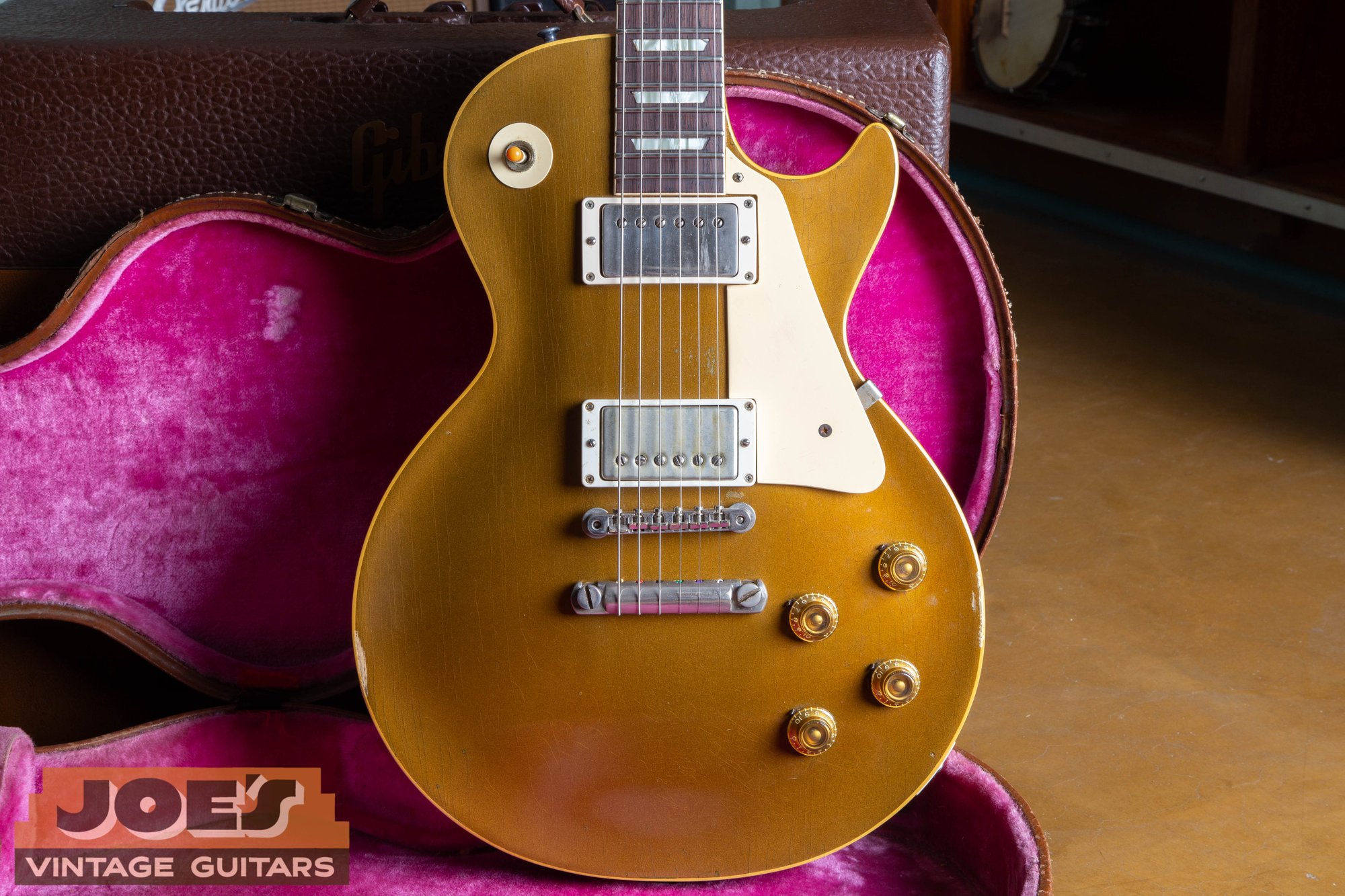
An owner might see those lines and think a fresh coat of paint would improve the guitar. For a collector, preserving a worn original finish can be far more desirable than replacing it. Refinishing changes an important part of the instrument’s history.
Checking alone cannot authenticate a finish. A specialist considers the finish together with the construction, parts and signs of previous work. The same care applies to pickups: a familiar-looking cover or label is one clue within a larger examination.
Maintenance deserves its own discussion. A professional refret can keep a guitar playable and is generally accepted on instruments that have been used. A broken headstock, reshaped neck or enlarged pickup cavity changes the assessment in other ways. Good descriptions explain the work and its quality.
The same questions apply to an old acoustic
The black Gibson L-00 pictured below brings the discussion closer to the kind of guitar a student might find in a family home. It is a 1930s acoustic with a very different design and playing purpose from the Les Paul. Its model, age, condition and history still deserve careful attention.
With an acoustic, the bridge, neck angle, cracks and previous repairs can affect both value and playability. High strings may point to work beyond a simple adjustment. A qualified repairer can help establish what the guitar needs before the owner decides how to proceed.
This is also where a student’s priorities belong in the conversation. A carefully repaired vintage acoustic may be a satisfying guitar to learn on. The questions are how it feels, whether it is structurally sound, and what it will cost to make it useful.
Keep the history with the guitar
An original receipt, repair invoice or dated family photograph can help establish an instrument’s history. A picture showing distinctive wear or wood grain may connect the guitar you have today with the person who played it decades ago.
Ask relatives what they remember while you can. Record who bought it, approximately when, and whether anyone recalls repairs or replacement parts. Keep the case, tags and old parts together. Even when the owner was never famous, a well-documented history can make a guitar easier to understand.
Before you clean it up or look for a price
Here is a useful first checklist for an older guitar:
- Take clear photographs of the front, back, headstock, bridge, identifying marks and case. Include damage and wear.
- Gather receipts, older photographs and any information about repairs. Write down the family’s account of where it came from.
- Hold off on polishing, refinishing, gluing or replacing parts until you know what you have. Leave internal inspection to someone experienced with vintage instruments.
- Get advice on both identification and condition. A vintage specialist can help with authenticity and value; a repairer can assess necessary work. Your teacher can help judge its suitability for lessons.
When comparing prices, look for completed sales of the same model and period with similar originality and condition. An asking price is a seller’s target, and a record auction result may reflect an exceptional instrument or documented celebrity ownership.
The 1957 Goldtop shows how valuable the right combination of model, period and surviving details can be. The L-00 shows why the same careful approach belongs with acoustics. Whatever is in the family case, start by learning what it is and preserving what came with it. That gives you a sound basis for deciding whether to play it, repair it, keep it or sell it.
Joe Dampt owns Joe’s Vintage Guitars in Mesa, Arizona, where he appraises, buys and sells vintage instruments.
Sources
- Joe’s Vintage Guitars — 1957 Les Paul Goldtop guide and photographed example
- Joe’s Vintage Guitars — Les Paul value guide (ranges reviewed July 2026)
- Gibson — History of the Les Paul model family
- Gibson — 1959 Les Paul Standard historical overview
- Gruhn Guitars — Preserving value, finishes and maintenance