Pretty much every acoustic guitar shop on earth has a wall of dreadnoughts. The shape is so normal now that it’s easy to forget it started as a side job. The first ones didn’t even say Martin on the headstock. They said Ditson.
Who was Ditson?
Oliver Ditson started out selling and publishing sheet music in Boston in the 1830s, and his company grew into one of the biggest music publishers in the country. They put out “Jingle Bells,” among a lot of other things. In 1867 his son Charles opened a New York branch, Chas. H. Ditson & Co., and the Ditson stores ended up selling instruments too.
Ditson was one of Martin’s biggest customers. Plenty of regular Martins went through their stores, some with a Ditson stamp in place of the Martin one. But the interesting stuff came from the New York store, where a manager named Harry L. Hunt started ordering guitars from Martin that weren’t like anything in Martin’s catalog.
Martin-made Ditson guitars
Around 1915 and 1916 the Hawaiian music craze was in full swing, and Ditson wanted more to sell than ukuleles. They asked Martin for their own line of guitars, with a wide waist and sloped shoulders that didn’t look like a normal Martin. The trim levels were 1, 2 and 3, and the number of digits told you the size: the 1 was Standard, the 11 was Concert, and the 111 was “Extra Large.” They had fan bracing, a bit heavier than Martin’s usual, which points to steel strings and Hawaiian slide playing. Martin also made Ditson ukuleles in the same shapes.
Why would Martin build somebody else’s guitars? Business was tough at the time, and Frank Henry Martin, who was running the company, was open to deals his father and grandfather probably wouldn’t have made, including building special lines for other companies. Ditson was a big, steady customer, and those were the years when ukuleles were keeping the Martin factory busy. In 1920 Martin made about twice as many ukes as guitars.
The big one
The Extra Large didn’t come out of nowhere. Hawaiian guitarist Major Kealakai had been touring with his band and wanted something louder, since this was way before PA systems. In March 1916 Martin shipped him a custom guitar, basically a 000 blown up bigger. Hunt asked Martin for a big guitar based on that one, but with the wide Ditson waist. A young Martin worker named John Deichman most likely helped build the prototype.
The first one, a Model 222, shipped to Ditson in August 1916. That same month the Music Trade Review announced “a new steel guitar called the ‘Dreadnought,'” said to have “the biggest tone of any instrument of its kind” and to be good for making phonograph records and playing big halls.
Left: a modern Martin with the original 12-fret dreadnought body, close to the Ditson shape. Right: the later 14-fret dreadnought. Photo: Tony 1212
Why “Dreadnought”?
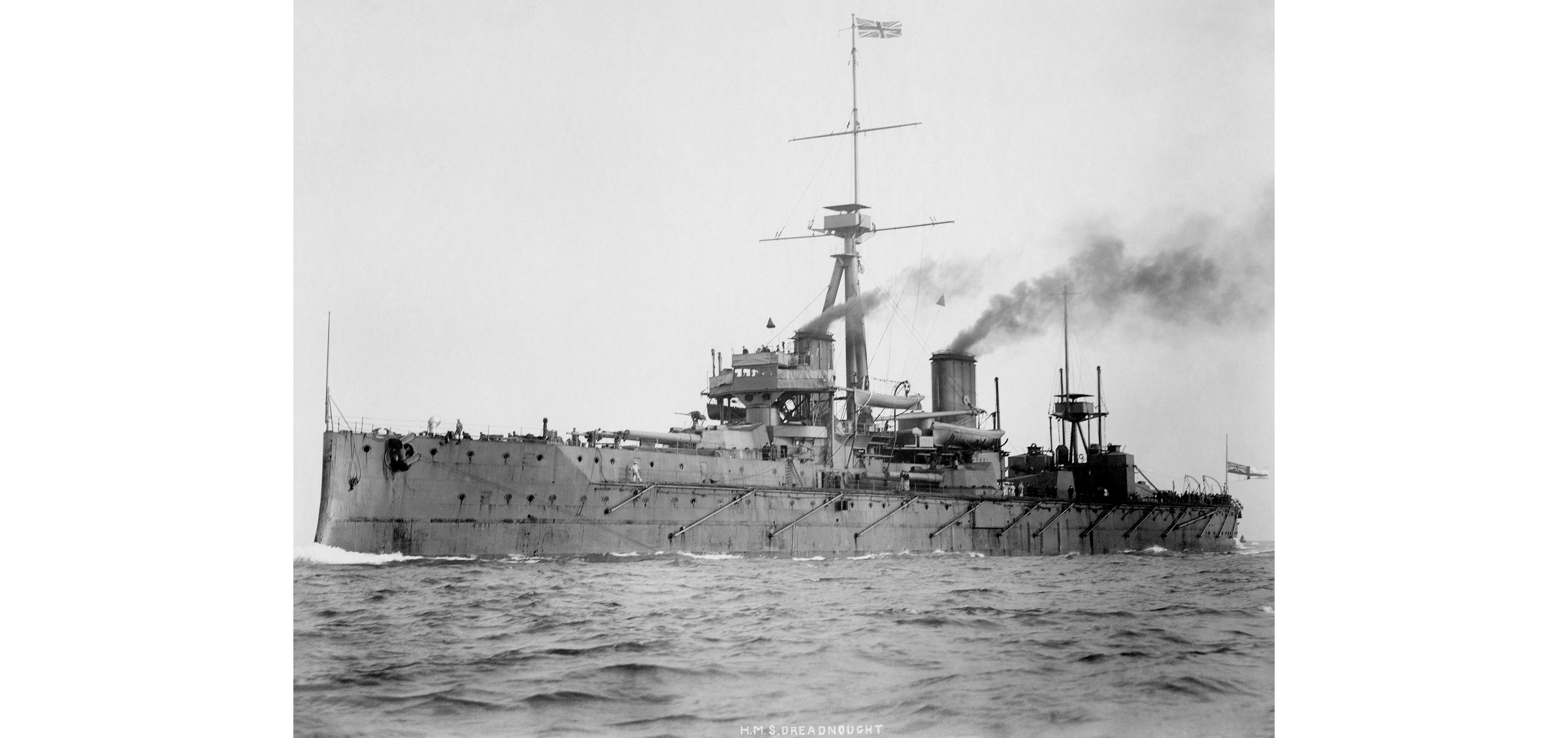
HMS Dreadnought was a British battleship that went into service in 1906. It was so far ahead of everything else that every older battleship suddenly looked outdated. Chris Martin IV says his grandfather told him it was Frank Henry Martin, a history buff, who named the company’s biggest guitar after the biggest battleship around. The early spelling was often “Dreadnaught.”
Nobody bought them
Here’s the funny part. They flopped. Only a handful of the big ones were made before Ditson pulled the plug on the line in 1921. Martin itself thought anything bigger than a 000 had too much bass, and Chris Martin says the first ones were called “bass” guitars.
Hunt kept pushing, though. Martin built a small number more for Ditson between 1923 and 1930, now with X bracing instead of fan bracing. The last ones were ordered in late 1930.
Martin takes it back
The Depression hit Ditson hard, and by 1931 the company was out of the picture. Martin still had the forms and patterns, though, so in 1931 it put out the dreadnought under its own name as the D-1 (mahogany) and D-2 (rosewood). Those were renamed the D-18 and D-28 almost right away.
Even then it was a slow start. For the first few years they were basically built to order. Then country and cowboy singers on the radio needed guitars that could hold their own in front of a microphone and a band. In 1934 Martin moved the neck joint to the 14th fret, and after that there was no looking back.
Ditsons today
The Martin-built Ditsons are rare finds now, especially the big ones. Not every Ditson-stamped guitar is a Martin, though, since other makers built for Ditson too. For the dreadnought’s 100th birthday in 2016, Martin did a limited D-222 100th Anniversary model with a 12-fret neck, a slotted headstock and a Ditson-style rosette. Martin couldn’t even find an original 222 to copy, so they worked from a surviving 111 in their collection.
If you’ve got a dreadnought around, play a big open G or E chord and just let it ring. That low end is exactly what Martin thought was too much in 1916.
Sources
- Ditson’s Style 11 and the Birth of the Dreadnought – Vintage Guitar
- The Big Gun: Martin Dreadnought Celebrates 100 Years – Acoustic Guitar
- The Journal of Acoustic Guitars, Vol. 5 (Jan 2016) – C.F. Martin & Co. magazine (PDF)
- The birth and evolution of the Martin D-18 Dreadnought – Guitar World
- Martins for the Ditson Company – earlymartin.com (Robert Corwin)
- Dreadnought (guitar type) – Wikipedia
- Oliver Ditson – Wikipedia
- HMS Dreadnought (1906) – Wikipedia
Top photo: HMS Dreadnought, around 1906-07. Photo: U.S. Naval History and Heritage Command